
Short answer
Gamma exposure (GEX) estimates how much stock option dealers must buy or sell to stay hedged as price moves. Where dealers are long gamma, their hedging works against price movement and volatility gets suppressed — price tends to pin. Where they are short gamma, their hedging works with price movement and amplifies it — moves accelerate. The strike where the sign flips is the level worth marking.
What gamma actually measures
Delta tells you how much an option's price moves for a $1 move in the underlying. Gamma tells you how much that delta itself changes. An option with high gamma has a delta that shifts quickly, which means anyone hedging it has to keep adjusting.
That last part is the whole story. Gamma matters to a retail trader not as a Greek on their own position, but because of what it forces the other side to do.
Why dealer positioning creates a force on price
When you buy a call, a market maker is usually on the other side. They do not want a directional bet — they want the spread. So they hedge by buying shares of the underlying, and as price moves they rebalance.
Which direction they rebalance depends on which side of the option they are on:
| Dealer position | Price rises | Price falls | Net effect |
|---|---|---|---|
| Long gamma | Sells stock | Buys stock | Dampens movement — price pins |
| Short gamma | Buys stock | Sells stock | Amplifies movement — moves extend |
A long-gamma dealer is mechanically leaning against every move. A short-gamma dealer is mechanically chasing it. This is not sentiment or a theory about who is smarter — it is a hedging obligation, and it produces the same behaviour regardless of what anyone believes about the market.
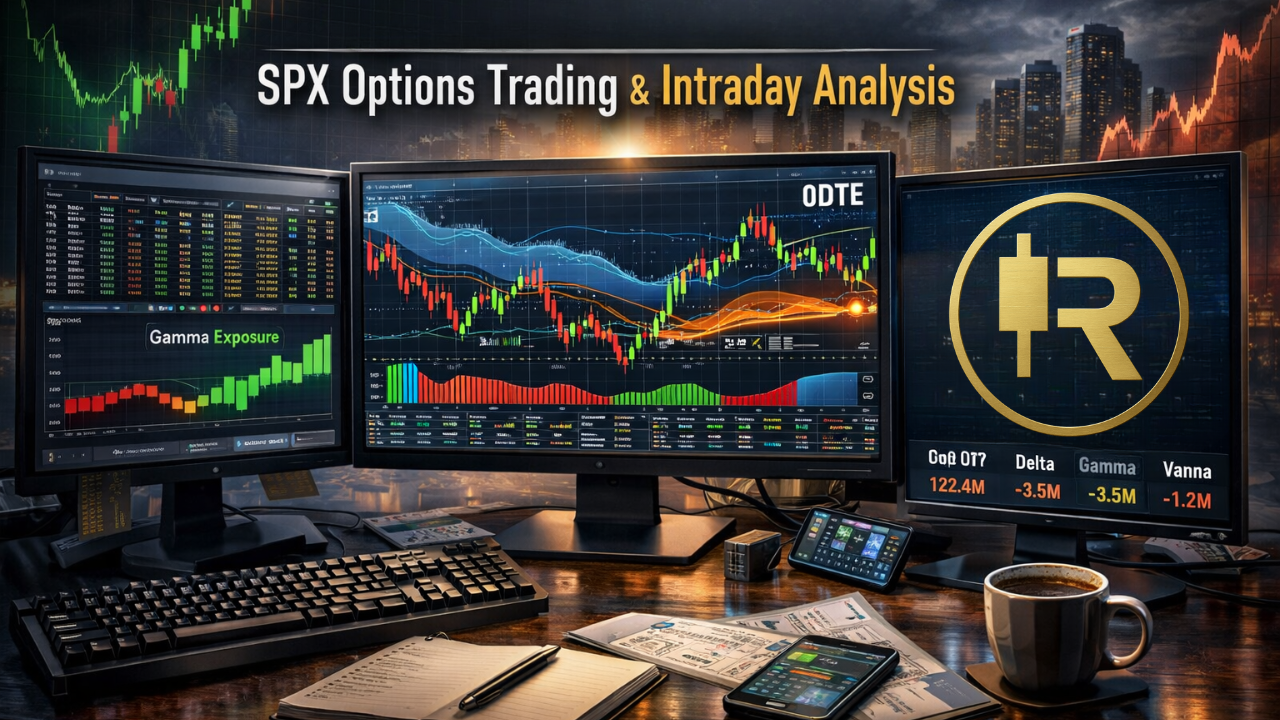
The three levels worth marking
The gamma flip
The price at which aggregate dealer gamma crosses from positive to negative. Above it, expect suppression and mean reversion; below it, expect trends to extend and volatility to expand. Crossing the flip level intraday often changes the character of the session entirely — the same setup that failed all morning starts working.
The call wall
The strike above spot with the largest positive gamma concentration. It behaves as resistance because dealer hedging into it is selling pressure. When it holds, price often ranges beneath it for the session.
The put wall
The mirror below spot. Often acts as support, and a decisive break through it tends to be violent because it usually coincides with the move into short-gamma territory.
See these levels called live
The desk marks gamma levels before the open and posts the alert when price arrives. Seven days for $7.
Start the trialCharm and vanna: why levels decay through the day
Two second-order Greeks explain why a level that mattered at 9:30 can be irrelevant by 2:00.
- Charm is delta decay over time. As expiry approaches, options drift toward delta 0 or 1, and dealers unwind hedges accordingly. This is a large part of why afternoon drift on expiration days is so persistent.
- Vanna is how delta changes with implied volatility. When IV falls, dealer hedges unwind in a direction that frequently supports price — the mechanism behind a lot of "melt-up on no news" sessions.
What GEX cannot tell you
It is a positioning map, not a signal. Three real limits:
- It is an estimate. Public GEX models infer dealer positioning from open interest and assumptions about who is long or short. Nobody outside the dealers knows for certain.
- It says nothing about timing. A level can sit untouched for days. That is why the desk pairs it with a structural trigger — see Smart Money Concepts.
- Macro overrides it. A CPI print or an unscheduled headline will run straight through a gamma wall.
How the desk uses it
Levels are mapped before the open and marked on the chart. During the session we wait for price to arrive at one with a sweep or imbalance behind it. If that happens, the alert goes out with the stop already set. If it does not, there is no trade — most marked levels never get touched. Full process on the methodology page.
Risk disclosure
Trading options involves substantial risk of loss and is not suitable for every investor. Options can expire worthless. It is possible to lose the entire amount paid for a position in a single session.
Rawstocks LLC is a trading education and analysis community. We are not a registered investment adviser or broker-dealer, and nothing published here constitutes personalized investment advice. Past performance does not indicate future results. Read the full disclosure.